
Any links to online stores should be assumed to be affiliates. The company or PR agency provides all or most review samples. They have no control over my content, and I provide my honest opinion.
Wi-Fi 7 capable hardware is slowly starting to become available, and in 2024, we should start to see a lot more products featuring it.
Recently, Intel became the latest company to announce new Wi-Fi 7 capable hardware.
Wi-Fi 7 Capable Routers, Laptops and Phones
So far, TP-Link has announced multiple Wi-Fi 7 products, including mesh systems, routers and access points. To the best of my knowledge, they are also the only company to have made the products available, albeit the supply is short and US only.
I am currently reviewing the Acer Swift Edge 16 laptop, and this must be one of the first laptops that has Wi-Fi 7. Normally, laptops use an Intel or Killer Wi-Fi module for the Wi-Fi, but this Acer laptop uses the Qualcomm FastConnect 7800.
Similarly, some phones use the Qualcomm FastConnect 7800 and have Wi-Fi 7 enabled. This includes the Xiaomi 13 Pro and the OnePlus 11.
It is worth noting that the just announced Apple iPhone 15 series lacks Wi-Fi 7.
Other companies have announced Wi-Fi 7 products, but they are not commercially available yet, at least in the UK.
Netgear has announced the Nighthawk RS700 router and, more recently, the flagship Netgear Orbi 970 Wi-Fi 7 mesh system.
ASUS has the ROG RT-BE96U and ROG Rapture GT-BE98.
Intel Wi-Fi 7 M.2 Modules – BE200, BE202, Killer 1750X
One important part of the Wi-Fi 7 rollout is the M.2 modules that are typically used on motherboards, in laptops and for Wi-Fi adaptors.
Intel has finally put up the product pages for two new Wi-Fi 7 modules with the product codes BE202 and BE200.
Intel states that both products have been launched (Q3’23).
Currently, specifics about the two modules are a little vague. The Intel page shows a very similar specifications for both products.
The one difference is that the BE200 is listed as Wi-Fi 7 Pre-certified, and they quote the maximum speed of 5 Gigabit.
The BE202 doesn’t state any max speed and it says the band is limited to 160MHz, whereas Wi-Fi 7 is capable of 320MHz.
The spec also makes no mention of Bluetooth, but this is likely to be Bluetooth 5.4 (or perhaps 5.3).
It is also believed that there will be an Intel Killer 1750X module, though this is not currently listed on the Intel website.
Interestingly, Intel has not revealed any modules that use the CNVio2 interface. Currently, the Wi-Fi 6E AX411 is M.2: CNVio2.
Currently, Mouser lists the BE202 with the product code BE202.D2WG.NV. You can buy this for a unit price of just £11.44 but you need to order in quantities of 1000.
Mouser also lists the BE201 (product code BE201.NGWG.NV) this will almost certainly be the CNVio2 variant.
Windows 10 Support
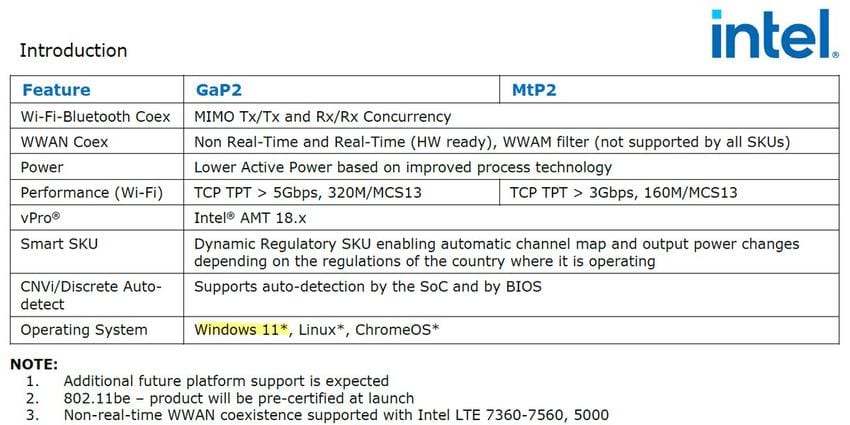
The product pages state that the supported operating systems are Windows 11, Windows 10, and Linux.
However, Windows 10 doesn’t properly support the 6GHz band, and there have been numerous reports that the only devices running the latest operating systems like Windows 11 will be provided with Wi-Fi 7 drivers.
The driver documentation shows that Wi-Fi 7 GaP2 will provide TCP TPT speeds up to 5Gbps (320M/MSC13), while MtP2 will offer speeds up to 3Gbps (160M/MSC13).
Intel Wi-Fi 7 BE200 vs BE202 AX210 vs AX411 Specifications
| Intel | BE202 | BE200 | AX411 | AX210 |
|---|---|---|---|---|
| Product Collection | Intel® Wi-Fi 7 Series | Intel® Wi-Fi 7 Series | Intel® Wi-Fi 6E (Gig+) Series | Intel® Wi-Fi 6E (Gig+) Series |
| Marketing Status | Launched | Launched | Launched | Launched |
| Launch Date | Q3’23 | Q3’23 | Q4’21 | Q4’20 |
| Weight (in grams) | 2230: 3.07+/-0.15 , 1216: 0.75+/-0.04 | 2230: 3.07+/-0.15G 1216:0.75+/-0.04G | 2.8 | 2.8 |
| Operating Temperature Range | 0 °C to 80 °C | 0 °C to 80 °C | 0°C to 80°C | 0°C to 80°C |
| Operating Temperature (Maximum) | 80 °C | 80 °C | 80 °C | 80 °C |
| Operating Temperature (Minimum) | 0 °C | 0 °C | 0 °C | 0 °C |
| Supported Operating Systems | Windows 11*, Windows 10*, Linux* | Windows 11*, Windows 10*, Linux* | Windows 11, 64-bit*, Windows 10, 64-bit*, Linux* | Windows 11, 64-bit*, Windows 10, 64-bit*, Linux* |
| Antenna | 2×2 | 2×2 | 2×2 | 2×2 |
| Recommended Customer Price | $12.84 – $20.33 | $11.00 – $33.00 | ||
| Supplemental Information | ||||
| Product Brief | View now | View now | View now | View now |
| Networking Specifications | ||||
| TX/RX Streams | 2×2 | 2X2 | 2×2 (Intel® Double Connect Technology) | 2×2 |
| Bands | 2.4, 5, 6 GHz (160MHz) | 2.4, 5, 6 GHz | 2.4, 5, 6 GHz (160MHz) | 2.4, 5, 6 GHz (160MHz) |
| Max Speed | 5 Gigabit | ~3.0 Gbps | 2.4 Gbps | |
| Wi-Fi CERTIFIED* | Wi-Fi 7 Pre-cerified | Wi-Fi 6E (802.11ax) | Wi-Fi 6E (802.11ax) | |
| Compliance | FIPS | FIPS | FIPS, FISMA | FIPS, FISMA |
| Integrated Bluetooth | Yes | Yes | ||
| Bluetooth Version | 5.3 | 5.3 | ||
| Package Specifications | ||||
| Board Form Factor | M.2 2230, M.2 1216 | M.2 2230, M.2 1216 | M.2 2230, M.2 1625 | M.2 2230, M.2 1216 |
| Package Size | 22mm x 30mm x 2.4mm, 12mm x 16mm x 1.7(+/-0.1)mm | 22mm x 30mm x 2.4mm, 12mm x 16mm x 1.7(+/-0.1)mm | 22mm x 30mm x 2.4mm, 16mm x 25mm x 2.0mm | 22mm x 30mm x 2.4mm, 12mm x 16mm x 1.65mm |
| System Interface Type | M.2: PCIe*, USB | M.2: PCIe*, USB | M.2: CNVio2 | Wi-Fi(PCIe), BT(USB) |
| Advanced Technologies | ||||
| MU-MIMO | Yes | Yes | Yes | Yes |
| Orthogonal Frequency-Division Multiple Access (OFDMA) | Yes | Yes | Yes | Yes |
| Supported Under Intel vPro® Technology | Yes | Yes | Yes | Yes |
| Intel® Smart Connect Technology | No | No |

I am James, a UK-based tech enthusiast and the Editor and Owner of Mighty Gadget, which I’ve proudly run since 2007. Passionate about all things technology, my expertise spans from computers and networking to mobile, wearables, and smart home devices.
As a fitness fanatic who loves running and cycling, I also have a keen interest in fitness-related technology, and I take every opportunity to cover this niche on my blog. My diverse interests allow me to bring a unique perspective to tech blogging, merging lifestyle, fitness, and the latest tech trends.
I’m proud to share that Vuelio has consistently ranked Mighty Gadget as one of the top technology blogs in the UK. With my dedication to technology and drive to share my insights, I aim to continue providing my readers with engaging and informative content.