Any links to online stores should be assumed to be affiliates. The company or PR agency provides all or most review samples. They have no control over my content, and I provide my honest opinion.
Last year, AMD launched the Ryzen 7 5800X3D with a massive increased L3 cache, tripling the 32MB on the Ryzen 7 5800X with 96MB of L3 cache.
This launch was largely geared towards gamers as the increased L3 cache is useful for the complex, heavy-dataset nature of video games.
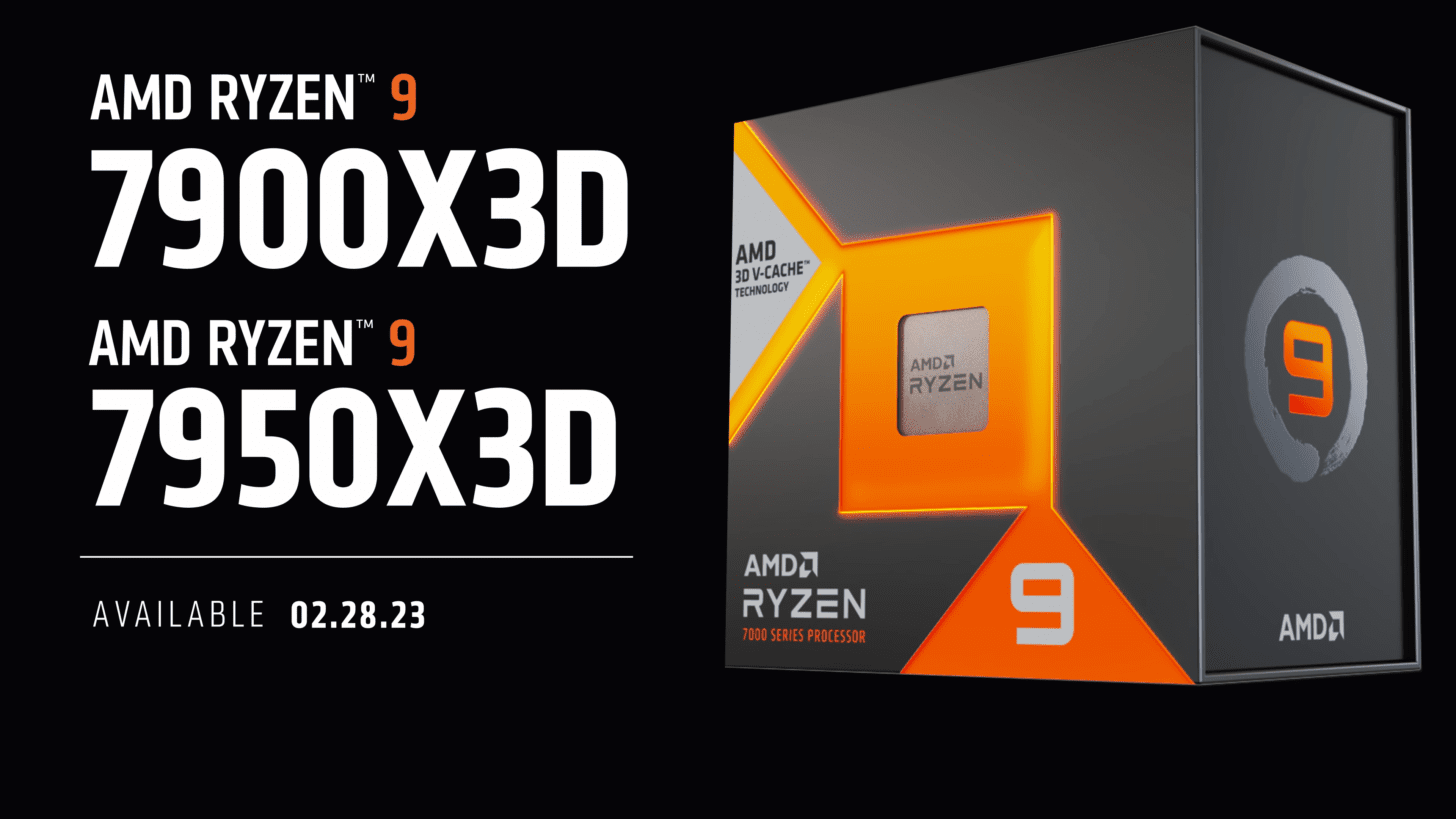
Following the success of that chip, AMD has not only launched its successor but expanded the range with an additional two CPUs with the multi-CCD Ryzen 9 chips.
What is AMD 3D V-Cache
The basics of AMD 3D V-Cache are largely self-explanatory from its name. AMD use a 3D stacking technology to stack a 64MB L3 cache die on top of their existing charge-coupled device (CCD). And a CCD is basically one CPU chiplet.
The existing CCD for each chipset is 32MB, and this then takes the L3 cache to 96 MB.
Ryzen 9 7900X3D & 7950X3D use different L3 cache per CCD
Interestingly, the Ryzen 9 7950X3D and Ryzen 9 7900X3D both have 128MB of L3 cache. That might look normal, considering it is double the cache of the non-3D CPUs, but we would have normally expected 192MB of L3 cache in total.
These two CPUs have two CCDs, and AMD has only applied the 3D V-Cache to one. One of the CCDs will have 96 MB, while the other will remain at 32MB.
This may look like they have cheeped out, and to some extent, they have, it is an expensive technology to implement, and that cost will be passed onto the customer.
However, there are benefits to this design too. Not all applications need such a large L3 cache, and more cache can introduce increased latency. Having one CCD with 32MB cache will allow them to clock higher for pure throughput workloads that wouldn’t benefit from the extra cache.
The 96 MB equipped CCD can then be used for things like gaming which will benefit from the L3 cache. The previous 5800X3D saw roughly a 15% improvement vs its vanilla Ryzen counterpart. We will hopefully see the same again with these new Ryzen 7000X3D chips.
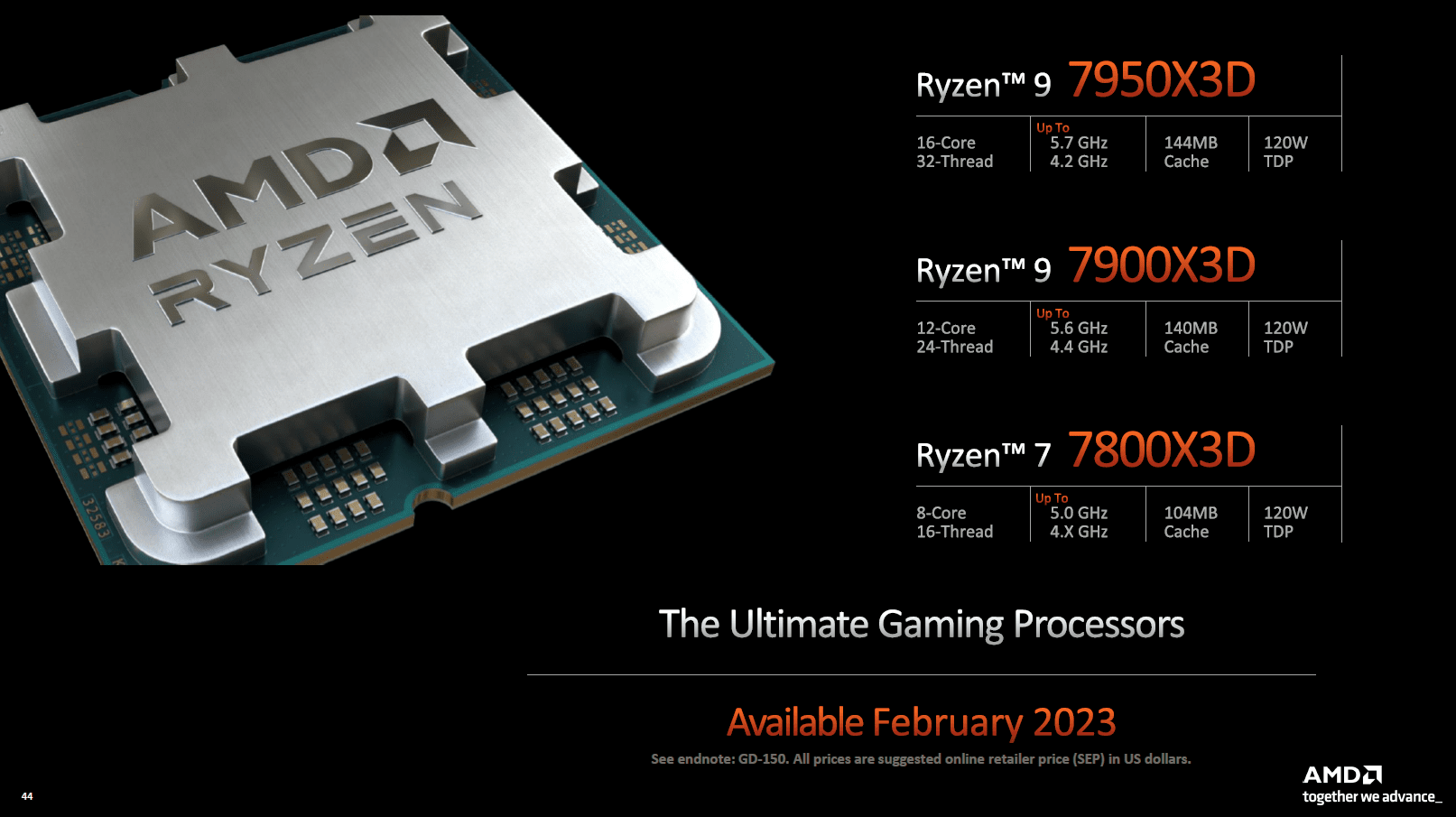
AMD Ryzen 9 7950X3D vs 7950X and Ryzen 7 7800X3D vs 7700X vs 5800X3D Specs & Price
| AMD Ryzen 7000X/X3D Series | |||||||
|---|---|---|---|---|---|---|---|
| Cores Threads | Base Freq | Turbo Freq | L3 Cache | TDP | Price | Release Date | |
| Ryzen 9 7950X3D | 16C / 32T | 4.2 GHz | 5.7 GHz | 128 MB | 120W | $699 | 02/28/23 |
| Ryzen 9 7950X | 16C / 32T | 4.5 GHz | 5.7 GHz | 64 MB | 170W | RRP: US$699 / €849 Current: $529 | – |
| Ryzen 9 7900X3D | 12C / 24T | 4.4 GHz | 5.6 GHz | 128 MB | 120W | $599 | 02/28/23 |
| Ryzen 9 7900X | 12C / 24T | 4.7 GHz | 5.6 GHz | 64 MB | 170W | RRP US$549 / €669 Current: $419 | – |
| Ryzen 7 7800X3D | 8C / 16T | 4.2 GHz | 5.0 GHz | 96 MB | 120W | $449 | 04/06/23 |
| Ryzen 7 7700X | 8C / 16T | 4.5 GHz | 5.4 GHz | 32 MB | 105W | RRP: US$399 / €479 Current: $344 | – |
| Ryzen 7 5800X3D | 8C / 16T | 3.4 GHz | 4.5 GHz | 96 MB | 105W | RRP: $449/£429 Current: $336 | – |
Motherboard Support
AMD’s new Ryzen 7000X3D processors will be supported on all of AMD’s AM5 series motherboards, though many motherboards will require a BIOS update to properly utilise AMD’s Zen 4 X3D silicon. Thankfully, all AM5 motherboards can have their BIOS updates without an installed processor, making BIOS updating a non-issue.

I am James, a UK-based tech enthusiast and the Editor and Owner of Mighty Gadget, which I’ve proudly run since 2007. Passionate about all things technology, my expertise spans from computers and networking to mobile, wearables, and smart home devices.
As a fitness fanatic who loves running and cycling, I also have a keen interest in fitness-related technology, and I take every opportunity to cover this niche on my blog. My diverse interests allow me to bring a unique perspective to tech blogging, merging lifestyle, fitness, and the latest tech trends.
I’m proud to share that Vuelio has consistently ranked Mighty Gadget as one of the top technology blogs in the UK. With my dedication to technology and drive to share my insights, I aim to continue providing my readers with engaging and informative content.