Soundcore Announces Seven New Products at CES 2026 Including AeroFit 2 Pro, Boom Go 3i & Nebula X1 Pro
Soundcore has expanded its audio and video lineup at CES 2026 with seven new products spanning wireless earbuds, portable speakers, projectors, and voice recording devices. The range includes everything from sleep-focused earbuds to a premium home cinema projector system, with launch dates extending through early 2026.
AeroFit 2 Pro: Dual-Form Earbuds

The standout announcement is the AeroFit 2 Pro, which Soundcore claims are the world’s first dual-form earbuds capable of switching between open-ear comfort and active noise cancellation. The product has received a CES Innovation Awards Honoree designation.
The concept addresses a genuine pain point. Traditionally, you’d need to choose between open-ear designs that maintain environmental awareness or closed-ear designs with ANC for focused listening. The AeroFit 2 Pro attempts to provide both in a single device.
Technical Implementation
The key mechanism is a five-level adjustable ear-hook structure with 56 degrees of articulation. In levels 1 and 2, the earbuds sit in an open-ear position. When adjusted to levels 4 and 5, the nozzle repositions closer to the ear canal entrance, creating a seal that enables passive isolation alongside active noise cancellation. Level 3 acts as a neutral position to prevent accidental switching.
Two built-in sensors per earbud (four total) automatically detect the wearing state and recalibrate the EQ in real time. This addresses the challenge of maintaining consistent audio performance across both modes, though I’d be interested to test whether the transitions are genuinely seamless or require manual adjustment.
The earbuds feature 11.8mm composite material drivers with TPU surround and LCP diaphragm. Soundcore’s Adaptive ANC 3.0 performs 380,000 environmental checks per second and can make up to 180 dynamic adjustments per minute. That’s impressive on paper, though real-world performance will depend on how well these algorithms handle rapid environmental changes.
Battery Life and Features
Battery performance varies by mode. In open-ear form, you get up to 7 hours per charge and 34 hours total with the charging case. Switch to ANC form and that drops to 5 hours per charge and 24 hours with the case. Using LDAC reduces battery life by approximately 3 hours in open-ear form and 2 hours in ANC form.
The earbuds include spatial audio with head tracking, LDAC support for high-resolution audio, IP55 water resistance with sweat guard protection, and a four-microphone array with AI noise reduction for calls. Fast charging provides 3.5 hours of playback from a 10-minute charge.
Each earbud weighs 10.4g, with the charging case adding 88.2g. Soundcore states the design fits roughly 90 per cent of the population with an ear diameter over 16mm.
Availability and Pricing
The AeroFit 2 Pro launches on soundcore.com on 6th January for $179.99 (approximately £145). Matte Black is available at launch, with Gloss White and Matte Purple following later in January, and Gloss Blue arriving in the coming months.
That pricing sits in an interesting position. It’s a touch high compared to standard open-ear earbuds, but if the dual-form mechanism works reliably, you’re effectively getting two types of earbuds in one device. The question is whether users will actually switch between modes regularly or simply settle into one preferred configuration.
Sleep A30 Special: Sleep-Focused Earbuds
The Sleep A30 Special targets the growing sleep technology market with a triple noise reduction system combining ANC, passive noise blocking, and adaptive snore masking technology.
The earbuds feature rich sleep content including Calm-branded sleep stories, AI brainwave audio, and various white noise options. They’re designed specifically for side sleepers with an ultra-comfort design. Sleep status monitoring is included, though details on the tracking methodology aren’t specified.
Pricing is set at $199.99 (approximately £160), with an embargo lifting on 5th January 2026 and launch following on 6th January 2026. The product is available in two colours based on the imagery.
It’s worth noting this is a relatively crowded market segment. The RRP is a touch high given that dedicated sleep earbuds need to compete on comfort above all else. I’ve reviewed similar products where the hardware was technically capable but uncomfortable for extended wear, which rather defeats the purpose.
Boom Go 3i: Portable Speaker
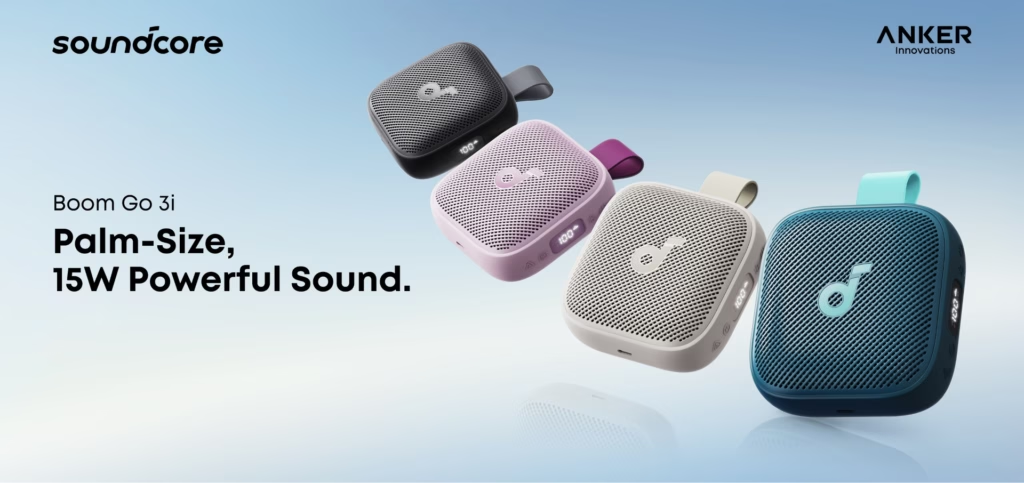
The Boom Go 3i is a palm-sized portable speaker targeting outdoor use. Key specifications include 15W power output, 22-hour battery life in Eco mode, a 4,800mAh battery that can provide emergency charging for other devices, and IP68 protection rating.
The speaker features a dual-mode mount strap system for multiple usage scenarios. Four colour options are shown, though the press materials note LED lighting colours will be finalised in January.
Pricing ranges from $65 to $80 (approximately £52 to £64), with embargo on 5th January 2026 and launch in March 2026. The MSRP range suggests different models or configurations, though this isn’t clarified in the materials.
That pricing is competitive for a 15W speaker with IP68 protection. The 22-hour battery claim is impressive, though I’d want to test real-world performance. Eco mode battery figures often involve reduced volume levels that might not be practical for outdoor use.
Nebula P1i: Portable Projector
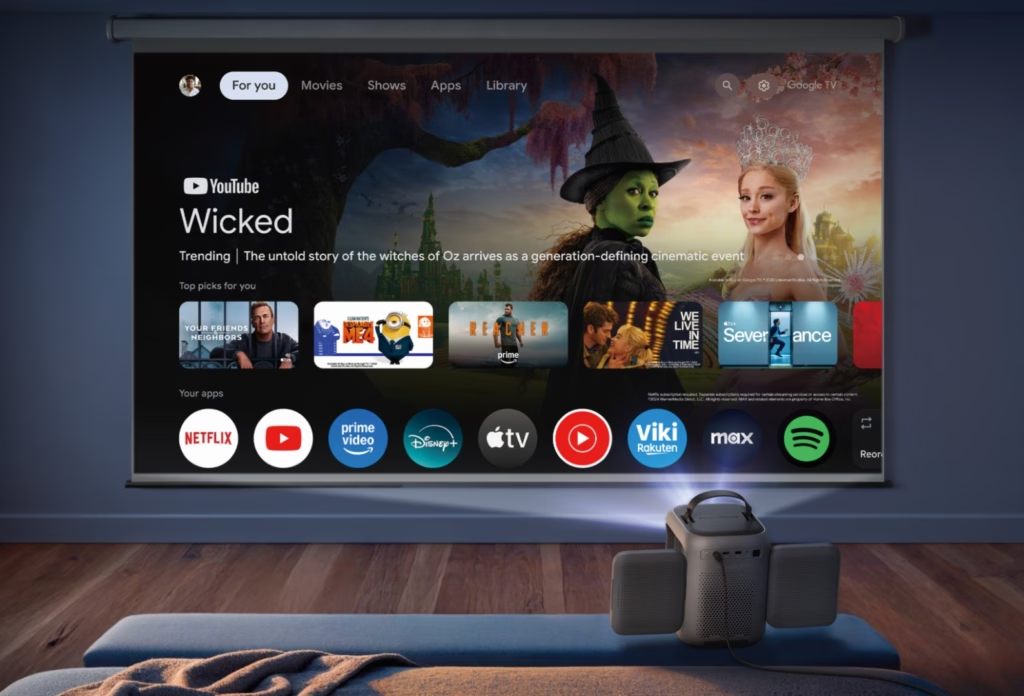
The Nebula P1i features a unique flip-open design with adjustable speakers for optimal sound positioning. Core specifications include 1080p resolution, 400 ANSI lumens output with TUV certification, official Netflix and Google TV integration with access to over 10,000 apps, and IEA 3.0 (Intelligent Environment Adaptation) with auto focus, auto keystone correction, and screen fit.
The portable design includes a built-in 0-12 degree tilt stand. Embargo lifts on 5th January 2026, with launch tentatively scheduled for early 2026 at $369 (approximately £295).
The 400 ANSI lumens output is fairly modest, which means this will require a darkened room for acceptable image quality. That’s not necessarily a limitation for a portable projector, but users should understand they’re not getting a bright enough image for well-lit environments. The IEA 3.0 features sound useful for reducing setup complexity, which is where portable projectors often frustrate users.
Nebula X1 Pro: Premium Home Theatre System
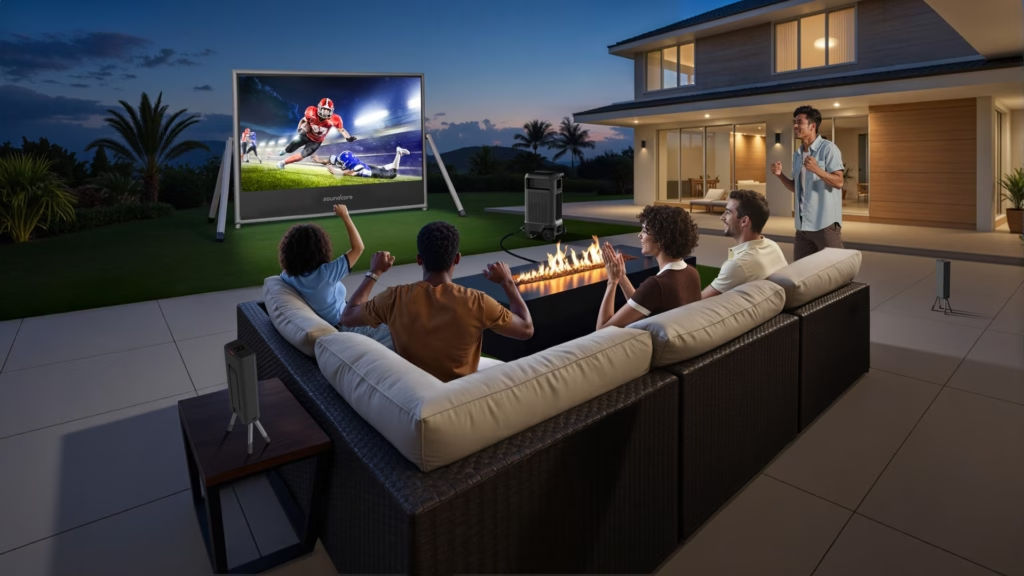
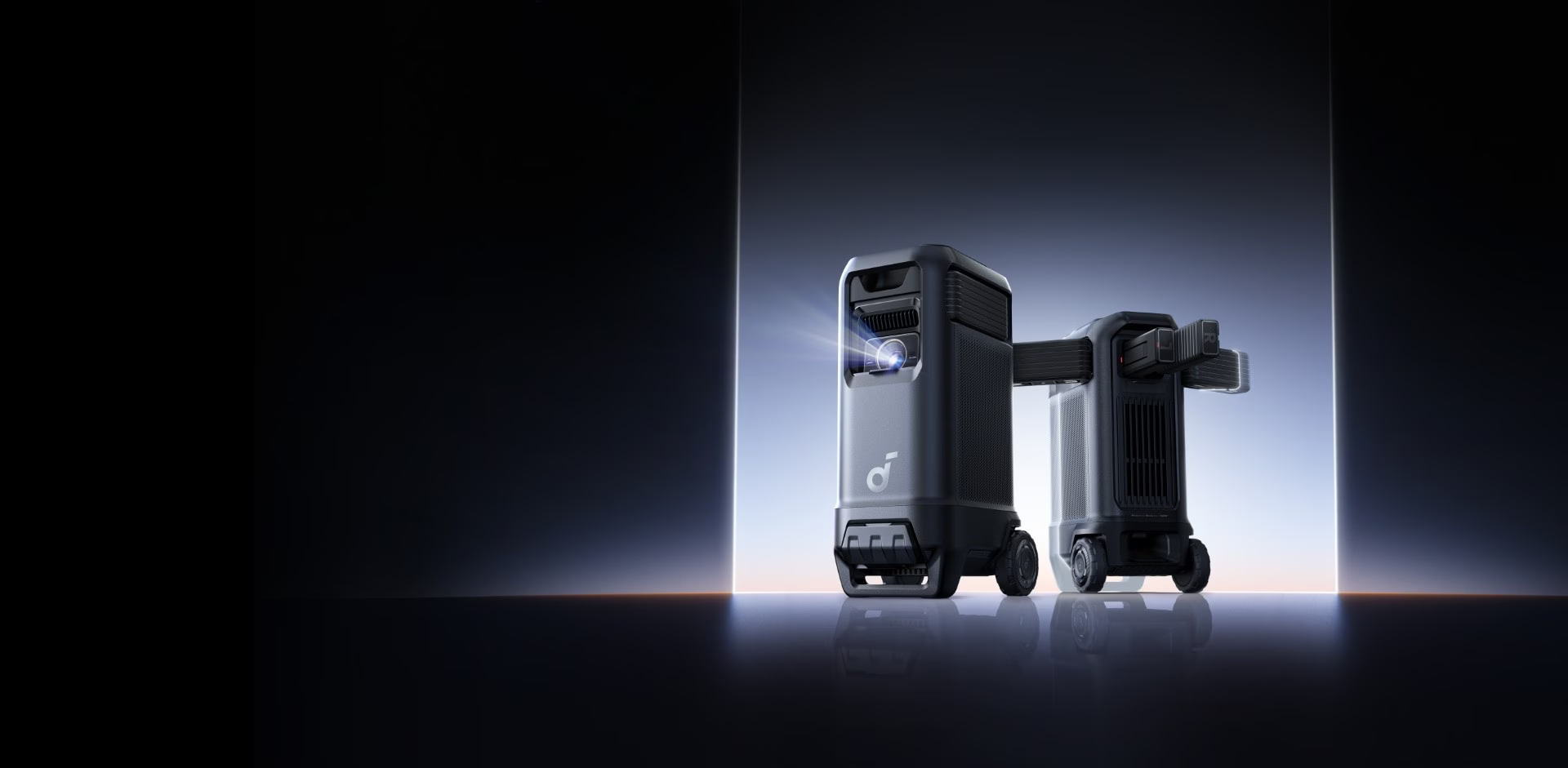
The Nebula X1 Pro represents Soundcore’s entry into the premium projector market. This is an all-in-one mobile theatre system with wireless speakers, dual microphones, and a retractable power cable.
The projector delivers 3,500 ANSI lumens brightness, 110 per cent Rec.2020 colour gamut coverage, 5,000:1 native contrast ratio, and 56,000:1 dynamic contrast ratio. It features the world’s first wireless 7.1.4 Dolby Atmos system for spatial audio.
The system launches tentatively on 20th January 2026 with two pricing tiers: $4,999 (approximately £4,000) for the Nebula X1 Pro projector alone, or $1,999 (approximately £1,600) for the 200-inch inflatable screen.
Those prices put this firmly in the premium market segment. The 3,500 ANSI lumens output is substantially brighter than the P1i, making this viable for rooms with ambient light. The 110 per cent Rec.2020 coverage is particularly noteworthy, as most consumer projectors struggle to exceed 80-90 per cent coverage of this colour space.
The wireless Dolby Atmos implementation is ambitious. Traditional home theatre setups require extensive cabling for surround systems, so if Soundcore has genuinely solved the latency and reliability challenges of wireless multi-channel audio, that’s a significant achievement. However, I’d want to test this extensively before recommending it, as wireless audio systems can suffer from synchronisation issues.
Soundcore Work: AI Voice Recorder

The Soundcore Work is a coin-sized voice recorder featuring AI-enhanced intelligent summarisation, AI-driven transcription with up to 97 per cent accuracy, double tap functionality to mark crucial moments, and MFi certification with privacy protection.
The device is available now on Soundcore.com for $159 (approximately £127).
The 97 per cent transcription accuracy claim is interesting, though accuracy varies significantly based on audio conditions, accents, and technical vocabulary. Most AI transcription services cite accuracy under ideal conditions, which rarely represents real-world usage. The MFi certification suggests iOS integration, which is sensible given Apple’s voice recording limitations.
At £127, this is competing against smartphone apps and dedicated recorders. The value proposition depends on whether the AI features genuinely save time compared to manual transcription or editing.
Availability Summary
Release dates vary significantly across the product line:
- AeroFit 2 Pro: 6th January 2026
- Sleep A30 Special: 6th January 2026
- Soundcore Work: Available now
- Boom Go 3i: March 2026
- Nebula P1i: Early 2026 (tentative)
- Nebula X1 Pro: 20th January 2026 (tentative)
Initial availability appears focused on Soundcore’s direct sales channel, with broader retail distribution announced later.
Final Thoughts
Soundcore’s CES 2026 announcements span an unusually broad range of product categories and price points. The lineup includes genuinely novel approaches like the AeroFit 2 Pro’s dual-form design alongside more conventional entries into established markets.
The technical specifications are generally competitive, though several products make claims that require independent verification. The move towards premium pricing with products like the Nebula X1 Pro represents a significant shift from Soundcore’s historically value-focused positioning.
Whether these products deliver on their specifications remains to be seen. The AeroFit 2 Pro’s mechanism is particularly interesting from an engineering perspective, while the Nebula X1 Pro’s wireless Dolby Atmos implementation could be either impressive or problematic depending on execution quality.
As always with new product announcements, the gap between marketing materials and real-world performance will only become clear once independent testing is possible. Several products in this lineup are attempting to address genuine user needs, but success will depend on execution details that aren’t fully apparent from press releases and specification sheets.